Wednesday, June 17, 2015

How to Plan an Awesome Tour of Machu Picchu and the Sacred Valley: Part 1 - Getting to Peru and Touring the Sacred Valley

Assuming you are now planning your own leg through the Sacred Valley and Machu Picchu, as explained in my earlier post, here's where you start.

View from the Lima Airport Wyndham: Not that Glamorous
In 2020, Cusco is going to open its first international airport, outside of the town of Chinchero. Locals are already investing in property around the town, when getting to Machu Picchu from New York will take only an eight hour flight and then a three hour train ride. Until then, the only way to get to Cusco and the Sacred Valley is through Lima.

Expedia lets you book flights from the U.S. through Lima into Cusco and then return from any other destination in Peru (such as Arequipa or Trujillo) back through Lima into the U.S. This saves you about $100 on each leg versus booking as four separate flights. If you want to stay overnight in Lima, however, you'll need to book your return from Lima and a separate leg from Arequipa, Cusco, or wherever you've ended up at the end of your Peru journey: return flights from other towns such as Arequipa all come in to Lima in the morning and for a single-booking return you'll need to take a late-night red-eye home on the same day. Plan the return carefully. If you are flying on a non-LAN-code-share airline such as United you can't check luggage through (no matter what the United agents may tell you in Newark). We missed seeing Lima as there was no place to store our luggage and the gate doesn't open for check-in until two hours before the flight. The only option is to plan an extra day in Lima at the end of your trip (which I'd recommend if we were doing it over again) or hire a tour guide in Lima that will take your luggage with you.

Cusco Airport
Speaking of checking luggage. When you arrive in Lima on United you must pick up your bags at the baggage claim and then recheck on to Cusco. Unsure if this is true on a code-share such as American, but best to wait at baggage claim and see - returning to baggage claim after you leave is a hassle that requires some elementary Spanish, Peruvian security, and an extra hour and a half. Best to stay with baggage claim in Lima to make sure your bags get safely checked on your morning flight.

Also - you will need to check in to each leg of the flight separately, but you need to be checked in and ready to fly on the first leg first. If you have a laptop with wi-fi that's easy enough to check in to the second leg on LAN (or United on the return) from the airport in the U.S. (or Arequipa, if flying back on a joined leg). This bit of double-check-in is a worrisome hassle but we had no problem checking in online once we flew the first leg of each portion. Peru has two major airlines - LAN and Peruvian. The LAN website has an English version that's as easy to use as any major U.S. airline.

Most flights from the U.S. arrive in Lima between 8 and 10pm, with onward flights to Cusco starting at 5:30am the next morning. You could hang out at the airport all night but I recommend booking a room at the Wyndham Costa del Sol Lima Airport - it's across the street from check-in and the Ikea-like rooms are serviceable enough to get a good nights sleep before a day of intense touring in high altitude. Don't be fooled by fashionable pictures on the hotel website: there's nothing memorable about this European, serviceable hotel, but you get two free tickets for Pisco Sours with your room and you'll be happy you got a bit of sleep. Or you can hang in the lobby and befriend other English speaking tourists headed off to or returning from deep jungle hikes. If you're like us you'll be excited to start your Peruvian adventure and so the Pisco Sours will be a necessary nightcap as a few hours of sound sleep is essential.

Leaving Lima
Flying Over the Andes
Start your day the next morning boarding a LAN flight to Cusco, along with a hundred other excited Peruvian families. Flying out of the coastal airport and up thirteen thousand feet into the Andes (the longest mountain range in the world) will be a great way to start to witness the beauty of the continent. Exiting the airplane in Cusco, you may, like me, feel dizzy, or slightly nauseated. Feet touching ground, you're at 11,150 feet above sea level. If it's June you'll feel a wintery nip in the air and want to zip up your jacket. If you heeded my first post, you've booked Tambo del Inka in the valley and are headed out of town. But how to get there?

Many who come to the Sacred Valley never leave
The best way is to hire a local guide who will drive you to your destination and spend the next three days showing you the sights and flavors of the Sacred Valley. The weather, countryside, and steep mountainous terrain of this valley is simply gorgeous. It's not for nothing that many Americans who pass through here go native: it's reminiscent of the high mountains around San Francisco in the Sixties, an enchanting destination all its own, with its own simple lifestyle, friendly people, and amazing fresh food and fresh air. We researched a few online recommendations and arranged an independent local guide, Oscar Zuniga, by emailing him at gascorth@hotmail.co.uk. Oscar doesn't have a web page as it's something of a bother to get one up in Peru. But he speaks good English, has studied tourism, and was a friendly, informative, and entertaining guide who made our first few days in Peru truly memorable. He comes highly recommended (if you contact him, mention you saw his name on my blog). Tambo del Inka and other major hotels will also book tour guides for you - though you will pay twice the price and they simply arrange someone like Oscar. But if having an official invoice is what you need that's what you may need to do. Take my word, however, Oscar was great, and needed no hotel middlemen (he used to work at Tambo and knows everyone there anyway).
Pisac Market

Oscar suggested our itinerary - visit Pisac and the Sunday market on our way to our hotel in Urubamba (a great start to our stay, the first day felt like an entire vacation all on its own). It was a great kick-off to the experience, though you may huff and puff your way up the hillsides at Pisac on your first day in the high altitude. Remember to take it easy and drink plenty of water, the Sacred Valley being a desert.
Alpaca Weavers of Chinchero

The second day he toured us around Chinchero, where we saw native weavings and the local

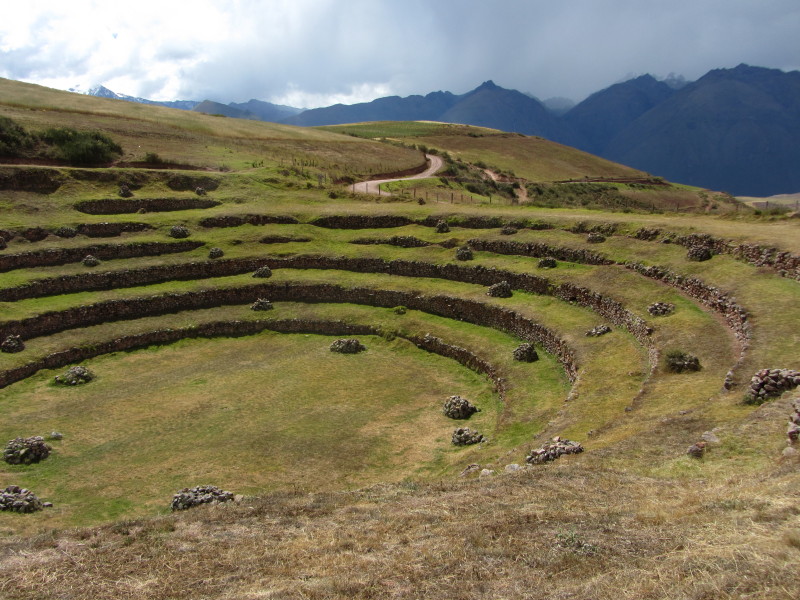
Agricultural Terraces of Moray

Salinas de Maras
church, along with stops at the amazing agricultural terraces at Moray and the salt farms at Salinas de Maras (both of which are must-sees, and start to give you real appreciation for the scientific achievements of the Inca civilization). Meanwhile, enjoy the hospitality at Tambo del Inka - they greet you with a cup of Coca tea (for altitude sickness) and check you in with hushed attention. Then off to spa, pool, or massage in between touring ancient wonders.
Tambo del Inka

The food at Tambo is okay (the outdoor bar is outstanding), but to really start to enjoy Peruvian cuisine, walk the short distance from the hotel to one of two most excellent restaurants. Tres Keros, which is a romantic second story family affair with simple but delicious grilled meats, or El Huacatay, which is recommended in the tour books. Getting off the hotel grounds also gives you a flavor for the local culture. (Hint: if you haven't noticed the Peruvian dogs running free by now, you will surely be commenting on their uncanny ability to avoid the cars. American dogs would be in mortal danger, here. Yet perhaps happier....)

The third day, check out of Tambo (say goodbye to paradise) and head for a day of touring at Ollantaytambo, the hiker's jumping-off point to Machu Picchu.

Ollantaytambo
The ruins at Ollantay are second only to Machu Picchu itself, and worth a good half day. Here you will see an Incan village still inhabited - tour the homes and bars, and sample the chicha corn beer. Learning about the Incas in Ollantay will provide all the background you need to start to appreciate the next leg: Machu Picchu itself. Be sure to slather on plenty of sun screen at Ollantay - there's no protection here, the coolish weather is deceptive, and I got a nasty burn on the back of my neck despite hats and SPF 90 on my face.

You will need to purchase your train tickets from Ollantay to Machu Picchu in advance. Do this on the PeruRail website a couple of weeks before you leave (in high season they will sell out the day of the trip). Despite what the website says, you can bring your luggage on board, but if you want to be super safe like me, you can email the PeruRail customer support office and ask for a pass for your luggage. They will send you a confirmation email specifying your luggage size, which you can show to the train conductors. This won't be needed but can be a comfort.

The hour and a half ride from Ollantay to Machu Picchu is an adventure in and of itself. You are headed lower in altitude and towards the Amazon, so the vegetation slowly changes from high desert to jungle. Watching the terrain change before your eyes, you realize you're headed to the higlight of your trip: the bucket-list item of Machu Picchu, a once-in-a-lifetime experience.

(Continue reading here....)


Sunday, June 14, 2015

How to Plan Your Own Tour of Peru and Machu Picchu

It's on most people's bucket list - a visit to the Inka wonder of Machu Picchu, an abandoned stone ruin high in the Peruvian Andes.

If you're eighteen you're going to set off with backpacks and hire a guide to take you along the four-day Inka trail, a hiking extravaganza with pitched tents and a couple of hostel stays (which you can only do accompanied by an official Peru outback guide company).

If you're a retiree, you're likely to connect with one of many Peru tour organizers. For five thousand a person they will book everything for you: buses, hotels, transfer points, and tickets. Just go where they say to and everything is arranged for you, with pre-set times and groups wondering the ruins together in the dozens.

However, if you're like us - middle-age adventurers who love to get away from the beaten trail, forge our own private path, and discover places and hikes all to ourselves - then you may opt to plan your own trip. If this were Italy or even China, that might not be too hard. But in a place like Peru it might be a challenge. We did it - and it was fantastic. However there are things you should know to make sure your Peruvian adventure goes as seamlessly as a five-star tour, without the crowds and pre-arranged cattle calls. Here are the pointers from our experience if you'd like to try this yourselves.

STEP 1: PLAN YOUR MAIN ITINERARY IN 1, 2, 3

Most working people going to Peru will have one to two weeks to tour the country before e-mail and cell phone messages back up to overflowing. First step is to decide how much time you'll have to reasonably escape. You'll be able to check email at major hotels and get cell reception in the towns of the Inca Valley, but internet in Peru is slower than American high-speed, so forget connecting to work on that fifty-tab Excel spreadsheet while you're gone (besides, you'll not want to sacrifice an evening or afternoon when you'll want to be recouperating from your hiking adventure with a Pisco Sour). Decide if one week, 10 days, or a full two weeks is how much you can reasonably escape. That will determining
the sights you choose.

LEG 1: THE ONE-WEEK ITINERARY (BASIC PERU STARTER TRIP)

If you've got a week, then you have no choice - you're going to the Sacred Valley and Machu Picchu, then heading back to Lima and home. These are the main attractions you are coming to see. And in fact, this first leg is the basic first leg on the 10-day and 14-day tours as well. The difference is that the longer two trips allow you to add one one or two side-trips additionally. But no one goes to Peru without the intention of visiting Machu Picchu - which will be the highlight of your trip, wherever you go. So plan this as the first leg of your visit, since you'll want to check off the bucket list item before anything else.
Our First View Into the Sacred Valley

For the first leg, all the tour books recommend the same thing - go straight through Lima on the way in country to Cusco (you can often book a flight straight through on Expedia and save about $100 a ticket), capital of the Sacred Valley, then immediately get out of Cusco for the lower altitudes down in the Sacred Valley, in order to ameliorate the altitude sickness (which is real, don't think just because you've been to the top of San Jaucinto in Palm Springs that it's anything similar). We stayed at Tambo del Inka in Urubamba, and believe me, you want to get to this hotel right away. It's the only 5-star LEED certified hotel in Peru, and as a destinatation it was a real highlight. If you leave on a Saturday, plan on one overnight through Lima to arrive Cusco early Sunday morning, then head out on your Sacred Valley tour (more on that in later posts) with Tambo del Inka as your destination. Two days to tour the valley, then up to Aguas Calientes and Machu Piccu for two more, then back to tour Cusco on Friday, Lima on Saturday, and home overnight Saturday for a Sunday morning arrival.
Tambo del Inka, Poolside

THE TEN-DAY and TWO-WEEK ITINERARIES

So, if you're staying longer, instead of heading to Lima on Saturday, this is where you can tack on one (or two, for two weeks) additional side-trips. Popular choices include Arequipa / Colca Canyon (which is what we did) for nature lovers, and Puno / Lake Titicaca to see some aquatic wonders. Other good options are Nazca (for the famous Nazca Lines), Trujillo for some northern flavor, and Iquitos for Amazon lovers. Here's a good overview of the highlights. For the ten-day itinerary, pick one of these. For a two-week itinerary, pick two.

We did a ten-day excursion and for us - with a doggie at home in Camp Bow Wow - it was long enough. We were ready to return to our own bed, have clean laundry (finding clean socks in the duffle bag becomes a challenge by Day 10), and see our doggie. Our choice of add-on was Arequipa / Colca Canyon, which did not disappoint - describing Colca Canyon as "twice as deep as the Grand Canyon," which it is - does not quite capture the wonderful terraces and beautiful light of the valley. It was much less traveled than the Inca Valley so offers great off-the-beaten-track adventures as well.

Colca Canyon
If we'd had longer we would have definitely added on Puno / Lake Titicaca, which is easy to get to from Arequipa / Colca Canyon (half a day's drive) and offers many wonders of its own...and the access from Arequipa means one less flight and a little less expense in transportation. But others may prefer a few days in the Amazon or a beach adventure. Up to you.

Once you've planned your itinerary, your next step is going to be to select hotels, book tickets, and arrange transportation and tour guides. More advice on how to get this started with Leg 1 in the next post: "How to Plan an Awesome Tour of Machu Picchu and the Sacred Valley"

Continue reading here....


Sunday, March 22, 2015

The Complete Product Manager - My Latest Blog

Working on a new blog - The Complete Product Manager - my blog on being a product management executive.

Hope my friends will take a look at let me know what they think. It's just a start and would like to add more content and resources over time.

Sunday, February 15, 2015

Rutgers Executive MBA - Two Years Later

I've written a post about why I chose Rutgers and another during the program. It's time a write my reflections two years later. What did it mean to me to get my EMBA at Rutgers and was it worth it?

Well, I must confess - now I'm teaching a course in the program (on digital marketing), so I can no longer write from an unbiased standpoint. I'm not only an alumni, I'm part of the program and an advocate, so take what I say with a grain of salt.

But perhaps this is the first point. That the experience was enriching and developed opportunities that I would have never expected - like the opportunity to teach. In pulling together the curriculum on digital marketing I learned as well to continue my own business learning journey and continued to find new sources to build upon my knowledge and capabilities. 

To the basic question: was it worth it. The answer is yes. In terms of career, I was promoted to Vice President soon after graduation. My income has risen accordingly. Many of my classmates have gone on to new jobs, promotions, and raises. One of my study partners was promoted to CEO of the U.S. office of his shipping firm. All of us had the potential but the MBA was a clear differentiator for each of us on our career track.

The real transformation, however, has been in my thinking. I hold conversations with our CEO, SVP of Corporate, and Board members of our public company and not only hold my own, but have insights to add. I see how investments and margins tie to EPS, can tackle a balance sheet or income statement with ease, have techniques to lead a room of executives on a new strategy, and routinely build risk assessment models for our business transformation. I had none of the tools or training to do these things before, and being able to think formally about finance, statistics, and corporate strategy has opened up new rewarding opportunities.

I have to confess, the biggest adjustment has been leaving the intense period of schooling behind. Getting back to having a life, having weekends, was at first a struggle, as I didn't know what to do with all that free time. I also had to learn how to not drop MBA terms at cocktail parties or work meetings. Eventually, however, I feel like the MBA has faded into the quilt of who I am and what I know - the same way I know how to develop and deploy software or write a short story. But it's a great thing to know and the Rutgers EMBA experience is one I'll always cherish. And work and life, somehow, always manages to rush in to consume the free time we thought we had.

Before I went to Rutgers, I wrote that "I'm doing it mainly because the material is relevant to my current job, it will give me the business background to make more strategic decisions, and it should, in some way, enhance my earning capabilities." Yes, it did do all that, and more. It exposed me to amazing professors and cutting edge business thinking. The quality of thinking and instruction in strategy, finance, and economics was as good as Ivy League, at half the price. It changed who I am and my confidence about my abilities. It gave me a new network of close friends. It developed my ability to relate to people, share life, and experience business in different cultures. It also gave me a community that I am still a part of and amazing experiences that will be remembered for a lifetime. But perhaps, most importantly, it made me rediscover my love of learning, and push myself to continually keep up with intellectual pace of change. It taught me how to be both a more insightful business thinker and a well-rounded leader. It was by no means an easy thing to do. But in accepting and meeting the challenge, it changed my life, in more ways than I had hoped or expected.

Tuesday, July 17, 2012

Back from China!

By the way, I've been back from China for a little over a month. It was incredible! I am working on a report for school, I will share on the blog - with pictures etc. - later this summer.

Meanwhile, just a few pics to give you a flavor. What an amazing once-in-a-lifetime experience.

 Great wall greatness.

Entrance to the Forbidden City.

 Howard Johnson's in Shanghai spells out something profound in Chinese.

 The view of PuDong from the Bund in Shanghai - what's all the electricity cost?

 Good friends were made into great ones!

Port of Shanghai - an amazing engineering feat built in 2 year.

Local transportation.

Hangzhou - West Lake - views that inspire Chinese lovers and poets.

Sunday, May 27, 2012

Executive MBA: Things You Can "Apply the Next Day"

So, with Year 1 of Rutgers Executive MBA done (off to China in a couple days), I have a bit of time to write again about the experience.

The year was amazing. A little like the Matrix movie where you jam twenty different skills into your head in the course of a few minutes. Plus new friends who will surely be friends for life. Just now beginning to dust off and decompress. Where to begin?

First, it's been nearly two and a half decades since I've been in graduate school. I'd forgotten how much I enjoyed learning. Being in this environment you really do get out what you put in. I maybe got a bit carried away because it also consumed more time away from life and family than it rightfully should. I probably pushed the edge a bit too much. Next year is about achieving more of a balance, carving out time during the week to spend away from both work and school. Difficult because between the two that's about 90 hours a week. Something has to give a bit and it will probably be school. That's hard, though, when I am really enjoying what I'm learning and seeing directly how to apply it to my career day by day.

People do talk about this so I just want to list a few of the things I learned that I was able to "apply the next day." Literally I would be applying something the same day I was doing homework or studying for an exam.

The two courses I applied most were financial accounting and financial management. Having never studied accounting or finance in college these were new to me - yet I've been working with financial statements and project financial analysis for years. Day by day I would learn something that was directly relevant to my work: whether it was GAAP for revenue recognition or IRR and discounted cash flow for project valuation, the very next day I could open up a file at work and make an improvement.

Other courses were relevant in a different way. In my strategic transformation class, I wrote a paper on a strategic transformation of my organization as it unfolded in real time, and was able to submit the appendix - a series of management recommendations - to my boss at the same time as we were re-organizing our group. Our international business class discussed a case on a foreign market entry: six weeks later, I was applying the same principals to our own foreign market entry at work.

When it came to linear programming in stats, I actually haven't used this one yet, but am planning to. A linear programming model applied to our selection of books for publication could yield fascinating results. I'm also hoping to apply the same type of analysis to Michael's consulting business.

If this were all, however, it wouldn't be so significant. The biggest change I've seen this year has been my confidence in myself and abilities in business. New skills in negotiations, leadership, and communications - combined with "talking the talk" when it comes to business lingo - have given me a leg up in any business setting. It isn't that the new deals I've closed this year or the progress I've made at work would not have happened without this program. It's that I'm comfortable working in the "Big Leagues," as it were. There really does seem to be a club of MBA-educated folks in a lot of leadership positions. Having the experience and references to speak their language puts you on an equal footing that would be difficult - not impossible, but just more difficult - to achieve otherwise. Maybe it's in the ways you see to connect the dots: between global economics, corporate finance, strategic management, and your day-to-day decisions about who to hire, how to lead a meeting, what to spend on thingamabobs, whether the CEO is doing a good job or not, or how many hours of your day to focus on x, y, or z. It doesn't change who you are, your experience or background, but it does give you personal clarity, and that extra bit of sparkle. That's hard to quantify but probably more valuable than all of those specific skills combined.

Now, off to China, then summer to recharge and reconnect with my family and friends, and then next year, when the program really gets interesting. Now if I can only get through with my marriage in tact, that's something to look forward to.

Sunday, November 13, 2011

The Executive MBA Experience: First Semester In

Decided to get an executive MBA was one of the biggest decisions I made recently - not only the time commitment, but spending a significant amount of money: how much to spend, which school to go to, whether I would have any life, how I would manage it with work, and all of that. The Exec MBA experience is like a roller coaster, and this September I got on. Many people have asked me what it's like so I thought this post might give people a view from this inside. We just finished our first semester mid-terms so this is a good time to pause for a moment and reflect (and believe me, there haven't been many opportunities to pause...).

In an earlier post I discussed my decision to go to Rutgers and now that I'm there the first thing to say is that I made the right choice. I really believe this program is unique in how it builds a sense of collaboration, trust, and friendship amongst the students. The academics are solid but more than just learning statistics or economics, what really comes out of the program is how to apply leadership and management skills as you work collaboratively with colleagues and professionals from a variety of geographic, industry, and ethnic backgrounds. These "soft skills," as we characterize them in publishing, are not the kinds of things I thought I needed to learn - but now that I'm here, I'm realizing this may be one of the most valuable experiences of the Exec MBA. The first semester at Rutgers fosters an environment where you can assimilate underlying academic basic (law, statistics, economics) that will be more applied in future semesters while also having a laboratory to practice essential business skills such as negotiation and leadership. I've never "studied" these skills before and going through that process is certainly useful. I feel like a vintage car being "tuned up" for business, and already have noticed its positive effect on how I do my job at work. I really think that Rutgers could market this aspect of the program more, because now that I am here, I realize this is probably the most essential thing I was looking for from my MBA, yet didn't know before I arrived.

In other words - before coming, I was focused on things like quality of networking, school reputation, or specifics of the curriculum (did they have a class on this or that interest). Really all external surface factors. The real experience is what the program can teach you about yourself (you get out of it what you put in, certainly) - how relevant you make the homework for yourself, and the quality of the teachers and program. I'm sure there are many schools that can impart these things but what I've discovered is that you can't predetermine where the MBA will take you before you come in. If you are really open to the MBA experience, you will dive deeply into it and let it transform you into the type of informed decision maker, leader, and business strategist who can make the best decisions about where to take your business and your career. This was my real goal, even though I didn't know it, and I'm excited that this two year experience will take me there. Things like career progress and salary will naturally follow.

So in a blink of an eye two months have gone by, an eighth of the program. Does it consume every moment of non-work time? Pretty much. Is it a relationship strain? Yes, but here are two things that help:

1. Really think through and prepare with your spouse what the family will need. Do you need extra day care, cleaning service? How will you help your spouse manage the extra work load falling to them?
2. No matter what you arrange, it will be a strain, so when you can, take evenings off to return to the family. Yes, you will feel strained and worried about school and work. But you start to learn how to keep up with readings, what you can skip or delay. An evening every other week will seem overwhelming to you and terribly infrequent to your spouse but you will both benefit from it.

The hardest part: your day job demands. As with any job, there are ebbs and flows to the overtime and weekends when work starts to back up or you need to travel. This is where the strong friendships and the group dynamics of the Rutgers program really pay off. If you are a good study group they will step in when you are traveling and you will return the favor. You will learn to get by with less sleep, but don't sacrifice your workout or exercise routine: staying in shape and eating healthy are essential to keeping up your stamina. The Exec MBA is a marathon, not a sprint, and you need to go in with proper discipline, but not panic and expend all your energy right away. You need to keep those daily things that keep you going, or you will quickly loose the energy you need.

Two months in, I feel I've gotten the flow. I've had to sacrifice not only hobbies and some favorite activities (like going to the movies or enjoying a fall hike) but also put off friends and cancel reunions with old acquaintances. But pacing yourself is important. A ten minute break to write this post, and now back to my law book for the rest of the day (and prepare for work tomorrow). That's the Sunday life of the exec MBA.

Saturday, October 15, 2011

Asia Trip: Days 4 and 5 - Hong Kong

On Wednesday, visited the International Islamic University of Malaysia on the outskirts of KL.

Beautiful campus in the hills. Then it was off on a three hour flight to Hong Kong.

Arrived at the JW Marriott late at night. Great, busy, business hotel - lot's of big meetings going on in lobby. Couldn't see anything at night but in morning, view of harbor was beautiful.

Hong Kong is GREAT city - New York in the hills of LA.


Only they are even more enamored of  shopping malls and brands than LA. Pacific Place is right next to the hotel, one of the swank malls.


Had a Harvey Nicks.

 Plus every big brand imaginable.


After meetings ended Thursday had a few hours to myself before heading home Friday. First tihing was checking out the Peak Tram to the top of the Hong Kong peak mountain.


Then later that night it was time for a night on the town with Nick and Glenn.


Highlight was the night market in Kowloon.


And of course the laser show at 8pm every night.


Tuesday, October 11, 2011

Asia Days 2 and 3: On to Kuala Lumpur

A day of business in Singapore - our office building


An evening of spicy crab.


Then off to Kuala Lumpur. This city - though Muslim - is less gentrified, a more diverse mixture of old and new, with a bit of an East Village vibe. Hotel Shangi-La is very nice.


People love their scooters here.


At night the city vibes with tropical bars....


Colorful lights hang from the big trees.

Petronis towers: